

Why Your Google Business Profile Matters More Than Your Website ?
For a healthcare practice, having a professional website is important. But when a potential patient searches for a doctor, clinic, or healthcare service nearby, they may encounter your Google Business Profile before they ever visit your website.
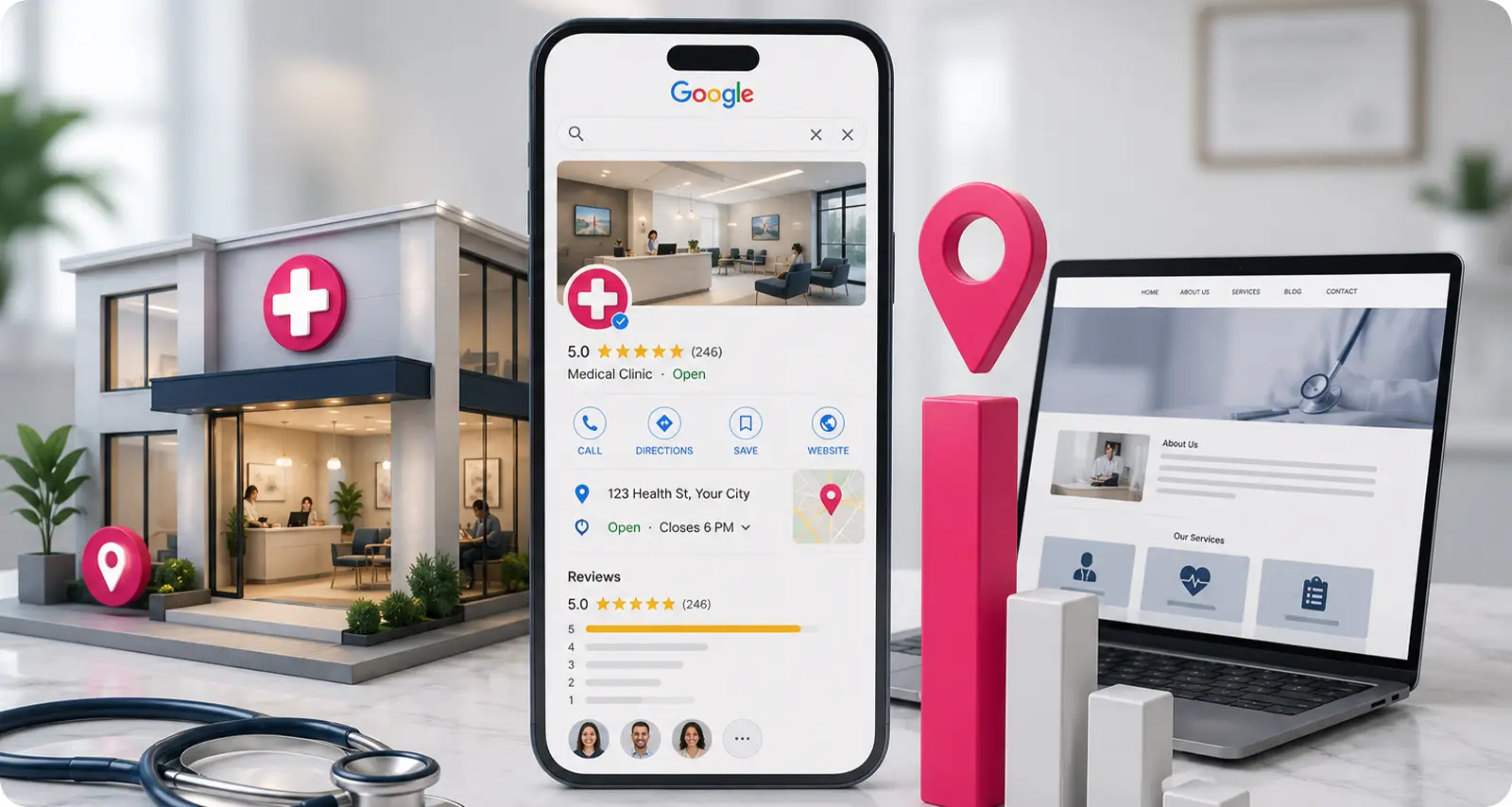
That first interaction can show your practice name, location, hours, phone number, services, photos, reviews, and directions directly in Google Search or Google Maps.
For local healthcare practices, this makes Google Business Profile more than a business listing. It can be one of the first places where patients discover your practice, evaluate it, and decide what to do next.
So, why can your Google Business Profile matter more than your website?
Because your website helps patients learn more about you after they find you, while your Google Business Profile can help your practice get discovered in the first place.
What Is a Google Business Profile?
Google Business Profile is Google’s business listing platform for helping businesses appear in Search and Maps.
For healthcare practices, it can provide patients with essential information without requiring them to navigate through multiple pages on your website.
A profile can include information such as:
- Practice name
- Address and location
- Phone number
- Business hours
- Healthcare category
- Services
- Photos and videos
- Patient reviews
- Website link
- Directions and other available actions
Google states that complete and accurate Business Profile information can help businesses appear in relevant local searches. Google also explains that local results are primarily influenced by relevance, distance, and prominence.
That makes the profile especially valuable for practices that depend on patients finding them within a particular geographic area.
Patients May Find Your Practice Before Your Website
Imagine someone searches:
“physical therapist near me”
or:
“foot doctor in [city]”
The patient may not begin by searching for your practice name. They are looking for a service and deciding among the providers Google presents.
Google Search and Maps can surface Business Profiles containing information about nearby practices. The patient can then see essential details, compare options, read reviews, check hours, and find directions.
Healthcare-focused marketing resources consistently identify this as one of the major reasons practices should treat Google Business Profile as an important part of their patient acquisition strategy.
Your website can be excellent, but it cannot help a patient choose your practice if the patient never reaches it.
Your Google Business Profile Builds Trust Before the Website Visit
Healthcare decisions involve trust.
Before contacting a practice, a potential patient may want to know:
- Is this the right type of provider?
- Is the practice nearby?
- Is it currently open?
- What services does it offer?
- What do other patients say?
- Does the practice look professional?
- How can I contact or reach it?
A Google Business Profile brings many of those answers together in one place.
Reviews are particularly important because they provide experiences from other patients directly within Google Search and Maps. Google itself notes that reviews can help businesses stand out and that responding to reviews demonstrates that customer feedback is valued.
For a healthcare practice, that makes your profile part of your online reputation; not simply an SEO asset.
Reviews Give Patients Social Proof
Your website can explain your services, introduce your providers, and communicate your brand.
But Google reviews provide something different: patient feedback displayed where people are already searching.
A potential patient can see your rating and reviews while comparing local providers.
That means your reputation can influence the decision before someone clicks through to your website.
Google recommends encouraging genuine reviews and responding to them. It also makes clear that businesses should not offer incentives in exchange for reviews or manipulate reviews.
For healthcare practices, the goal should therefore be simple:
Deliver a strong patient experience, make it easy for patients to leave genuine feedback, and respond professionally to reviews.
Google Business Profile Helps You Compete in Local Search
A website can rank for valuable searches, but local healthcare discovery has another important layer: Google’s local results and Maps.
Google explains that local ranking is mainly based on:
Relevance
How closely your Business Profile matches what the patient is searching for.
Complete and detailed information can help Google understand your practice and match it with relevant searches.
Distance
How close the practice is to the person searching.
For healthcare businesses serving a specific community, this makes location an important part of local discovery.
Prominence
How well-known a business is.
Google notes that prominence can be influenced by information such as links from other websites and reviews, with more reviews and positive ratings potentially helping local ranking.
These factors make Google Business Profile particularly relevant to practices competing for attention in their local market.
Your Website and Google Business Profile Do Different Jobs
The real question should not be:
“Should I have a website or a Google Business Profile?”
You should have both.
The better question is:
“What job should each one perform?”
| Google Business Profile | Healthcare Website |
| Helps patients discover your practice locally | Gives patients deeper information |
| Appears in Google Search and Maps | Provides your full digital presence |
| Displays reviews and ratings | Explains services in greater detail |
| Shows location and hours | Introduces providers and practice information |
| Makes contacting the practice easier | Can provide appointment and patient journeys |
| Supports local search visibility | Supports broader SEO and content |
| Creates an important first impression | Builds on that first impression |
Healthcare marketing resources emphasize that GBP and a website are complementary rather than interchangeable.
Think of your Google Business Profile as a front door to your online presence.
Your website is where the patient can continue exploring once they walk through it.
What Your Google Business Profile Should Include
A profile that is incomplete or outdated can create unnecessary friction for potential patients.
Google recommends keeping business information complete and accurate, including information such as your address, business category, and hours.
For a healthcare practice, pay particular attention to:
1. Accurate Practice Information
Make sure your name, address, phone number, hours, and other essential information are correct.
Patients should not have to search elsewhere to confirm basic details.
2. The Right Business Category
Your category helps Google understand what your business is and how it relates to searches.
Use the cate
3. Services
Clearly communicate the services your practice provides so patients and Google can better understand what you offer.
4. Photos and Videos
Visual content gives prospective patients another way to understand your practice.
Google specifically recommends adding photos and videos to Business Profiles to show customers what a business offers and tell its story.
5. Genuine Reviews
Encourage patients to share honest experiences and make review management part of your ongoing reputation strategy.
6. Professional Responses
Responding to reviews shows that your practice pays attention to patient feedback. Google recommends responding to reviews as part of managing your Business Profile.
7. Website and Booking Path
Your profile should not compete with your website. It should guide interested patients toward the next step, whether that means visiting your website, contacting the practice, getting directions, or using an available booking option.
Why “Set It and Forget It” Does Not Work
Creating a Business Profile is only the beginning.
Healthcare-focused sources recommend treating GBP optimization as an ongoing process rather than a one-time setup. Keeping information current, managing reviews, and maintaining fresh photos and other profile elements helps keep the listing useful and relevant.
This matters because healthcare practices change.
Your:
- Hours may change.
- Services may expand.
- Providers may join or leave.
- Photos may become outdated.
- Patient reviews continue to accumulate.
- Booking processes may change.
Your Google Business Profile should reflect the practice patients will actually encounter.
A Simple Google Business Profile Checklist for Healthcare Practices
Use this checklist to review your profile:
Business information
- Practice name is accurate
- Address is correct
- Phone number is correct
- Regular hours are updated
- Special hours are updated when necessary
Profile relevance
- Correct primary category is selected
- Services are accurately listed
- Practice information is complete
Trust
- Genuine patient reviews are being collected
- Reviews are monitored
- Reviews receive professional responses
Visual presence
- Practice photos are current
- Relevant photos and videos are included
Patient journey
- Website link works
- Patients can easily find contact information
- Directions are accurate
- Available booking options are easy to access
Google emphasizes that businesses cannot simply pay for better local ranking. Instead, practices should focus on providing complete information and improving their local presence through the factors Google uses to determine local results.
Your Website Still Matters, But It Should Not Work Alone
Calling your Google Business Profile more important than your website does not mean your website is unimportant.
Your website remains an essential part of your healthcare practice’s digital presence.
It can provide detailed service information, introduce your providers, explain your approach, answer patient questions, and guide visitors toward appointments.
But your website and GBP serve different stages of the patient journey.
Google Business Profile helps patients discover and evaluate your practice locally.
Your website gives them a deeper place to learn, understand, and take action.
XoomMD’s own approach to healthcare growth follows this connected model: helping practices improve visibility, establish trust, and convert the right patients rather than treating individual digital channels as isolated tools.
Final Thoughts
For a local healthcare practice, your Google Business Profile can be one of the most important digital touchpoints you manage.
It puts your practice in front of people searching for healthcare services nearby, gives them essential information immediately, displays patient reviews, and provides a direct path toward contacting or visiting your practice.
Your website remains important, but it should not be the only part of your online presence receiving attention.
If your website is your digital front desk, your Google Business Profile is often the sign that helps patients find the door.
Make sure both are working together.
For healthcare practices looking to improve online visibility, patient trust, and the journey from Google search to appointment, XoomMD provides connected healthcare growth solutions built around how patients search, evaluate, and choose providers.